


TL;DR
Most leaders do not struggle with the future because they lack methods. They struggle because methods are steps, and the future is music, and knowing one has almost nothing to do with hearing the other. This issue is about the difference between analyzing the future and moving with it, and how working backward from a future you actually want turns paralysis into decisions you can make this quarter. By the end, you will know how to build that backward path, which signals should change your mind, and why you are allowed to start before you feel ready.
Standing at the Edge of the Floor
A particular kind of silence falls over a leadership team when the analysis is finished and the moment to decide arrives. The walls are covered in trend cards. The scenario matrices are immaculate. Everyone in the room is smart, prepared, and completely still. I have stood inside that silence more times than I want to admit, sometimes as the facilitator holding the marker, and sometimes, if I am honest, as the person who could not move.
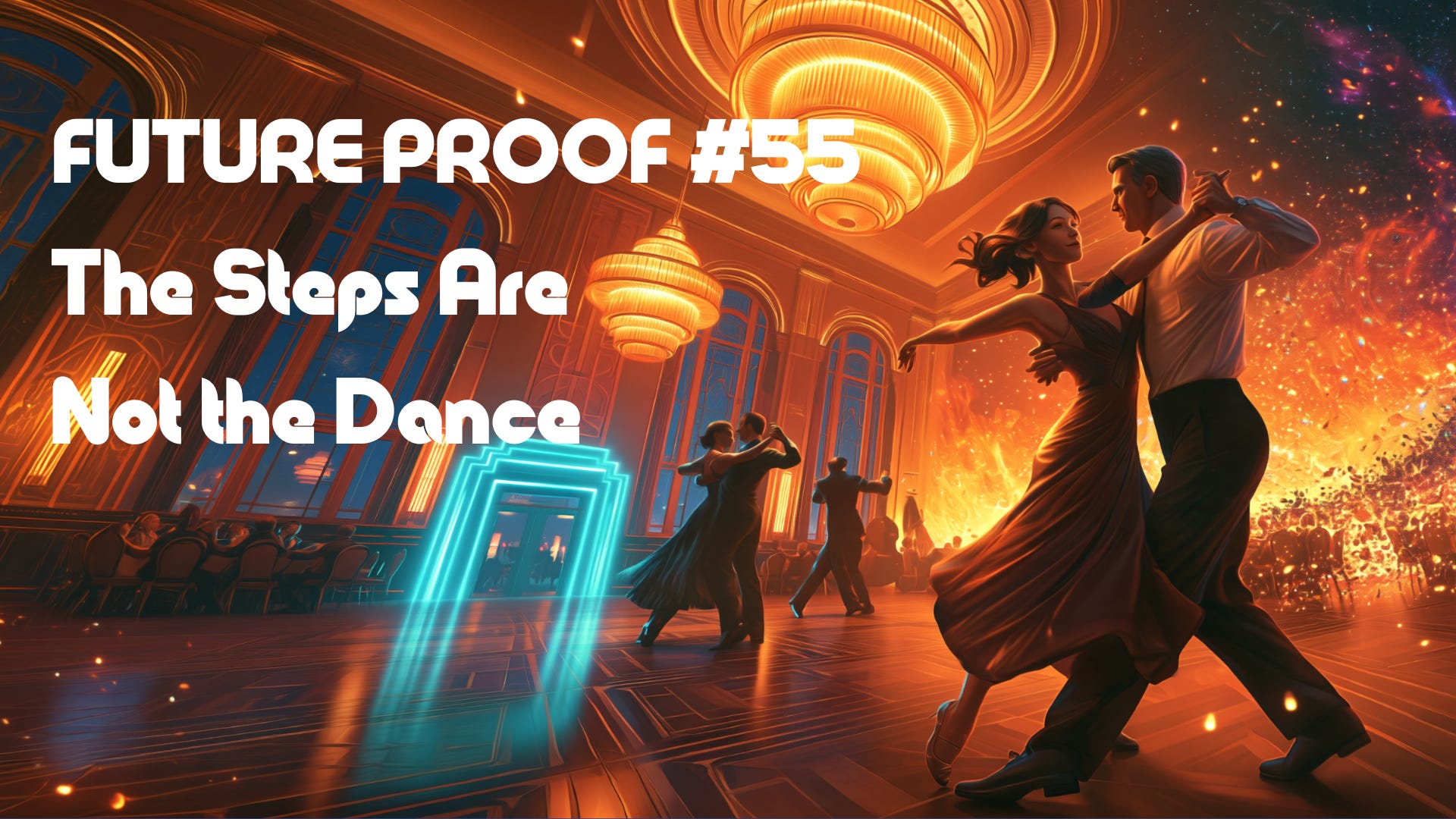
A friend of mine, a professional futurist, has a way of explaining this moment that I have not been able to shake since she first said it to me. She grew up as a competitive dancer, competed in Latin tournaments as a teenager, and then went the other direction entirely, into physics and engineering and a corporate strategy career, before foresight found her and pulled the two halves of her back together. She told me that teaching someone a foresight method is like teaching them the steps to a dance. She can hand you the steps to trend analysis or scenario planning the same way she could hand you the steps to a salsa, numbered and diagrammed and complete. But if she pushed you onto the dance floor with nothing but the steps, you would stand there feeling awkward and exposed, unable to hear the rhythm, unable to move. The steps were never the dance. The music is the future, and most of us were never taught to hear it.
That image explains almost everything I see in rooms where strategy is supposed to happen. The organizations I work with are not short on tools. They are short on the felt sense of what the tools are for, which is not prediction and not certainty but something closer to anticipation, the thing a good dancer has when she feels the drop coming half a beat before it arrives.
Why the Steps Feel Safer
Here is the uncomfortable part, and I include myself in it fully. The steps are not just easier than the dance. They are safer, and some part of us knows it. Another framework, another round of analysis, another quarter of watching the data mature: each one is a legitimate professional activity that also postpones the moment when we have to commit to something in public and risk being wrong. Analysis can be a form of courage, but it can also be a very sophisticated form of hiding, and from the outside the two look identical.
I have real empathy for this, because the fear underneath it is not irrational. The future genuinely is uncertain, the pace genuinely has accelerated, and the cost of a visible mistake in most organizations genuinely is higher than the cost of an invisible delay. So people stand at the edge of the floor, holding their step diagrams, waiting for the music to become predictable. It never does. Meanwhile, the cost accumulates in places no dashboard measures, in the decisions that were never made, the options that quietly expired, and the slow leak of belief inside teams who can sense that nobody upstairs can describe a future worth working toward.
My friend sees this leak everywhere right now, and she connects it to something most productivity conversations miss entirely. When a country or a company concludes that its people are not working hard enough, the reflex is to demand more hours and tighter rules. But she argues the real deficit is almost never effort. It is the missing picture of a future people actually want to help build. Motivation does not come from surveillance; it comes from being able to see what your work is for, and when that picture is absent, no amount of pressure fills the hole where purpose used to be.
Learning to Lead and Follow
The reframe she offers, and the one I want to hand you, starts with admitting that we approach the future from two directions at once. There is the push of the present: all the data, trends, and extrapolations that tell us where current momentum wants to carry us. And there is the pull of the future, the imagined destinations that draw us forward and make some decisions feel worth the risk. Neither direction is sufficient on its own. Extrapolation without imagination produces a strategy that is precise about a world nobody wants, while imagination without grounding produces a vision board. The real work happens in the gap between the push and the pull, where the data runs out, and the deciding begins.
This is where the dance metaphor earns its keep, because partner dancing has a vocabulary for living in that gap. Sometimes you follow, sensing your partner’s weight shift, adapting in real time, letting the situation lead. Sometimes you lead, committing to a direction and trusting the connection to carry you both through it. A rigid tournament routine, memorized and identical every time, is neither of these things. It is choreography, and choreography breaks the moment the music changes. What she teaches organizations, and what I have come to believe is the actual skill underneath all the frameworks, is when to follow the future and when to lead it, when to sense and adapt and when to commit and shape. Organizations that only follow become permanently reactive, and organizations that only lead become brittle, but organizations that can switch between the two develop something that looks, from the outside, remarkably like grace.
Walking Backward from the Future
So what does moving actually look like, once you step onto the floor? The practice I find most powerful runs the roadmap in reverse. Instead of standing in the present and staring across the distance at some far destination, cataloging every obstacle between here and there, you start by describing a future worth wanting, in enough detail that people could recognize it if they arrived. Then you walk backward. If that is where you are in 2036, what must already be true in 2033? What must have happened by 2030 to make 2033 possible? What does that chain of necessity imply about the next four quarters? The distance that felt paralyzing when you faced it forward becomes, when you walk backward, a sequence of nearer, more decidable moves, each anchored to the one behind it.
The objection arrives immediately, and it is fair. That preferred future is optimistic, people say, maybe even utopian, and the honest answer is yes, and also that it is no less likely than any other single future you might name, because no single future is likely. The picture is not a prediction. It is an orientation, a fixed star you steer by while fully expecting uncooperative winds. Which is why the second half of the practice matters just as much: you take that backward path and stress it against genuinely different worlds. What happens to this plan in a collapse, in a transformation that outruns you, in a decade of scarce resources? Some moves survive every world you test them in, and those become your core bets. Others only make sense in one future, and those you hold more lightly, as probes rather than commitments.
What falls out of this exercise is the most practical artifact in all of foresight work, a short watch list of specific signals attached to agreed responses. When this indicator moves, we accelerate. When that one appears, we revisit the bet. My friend calls the hopeful half of this seeing the pockets of hope, the small live trends that your preferred future needs and that you can start feeding today, and she is right that you literally cannot see them until you have imagined the future they belong to. Attention follows intention. The watch list is how you make that a discipline, not an accident.
Your Own Dance Card
Everything I have described scales down to a single life, and this is where I want to slow down, because most of us are running our careers the way those frozen organizations run their strategy. My friend told me about a signal she spotted recently that has stayed with me for weeks: groups of young people in her region gathering to eat pudding with forks under a bridge. It sounds absurd until you sit with it. They are inventing deliberately strange rituals because the ordinary social spaces where people used to find each other have thinned out of daily life, and the hunger for real connection is strong enough to improvise its own venues. She sees the same restlessness in people who now plan to work for two years and then step away for two more, reinventing themselves in cycles rather than waiting for a retirement that feels both distant and uncertain.
You do not need a strategy department to work with signals like these. The personal version of the loop is almost embarrassingly small. Describe the future version of you that you would actually want to meet, walk backward from her to this year and then to this week, and let that chain choose one move each day that your future self is depending on. Notice one signal a day that confirms or challenges the path you are on, and give yourself a short weekly appointment to ask what you learned and what assumption deserves updating. None of this requires certainty. All of it requires motion, and motion is precisely the thing the frozen version of us keeps deferring until conditions improve.
The Music Has Already Changed
Here is the discipline, and I say this with affection for everyone standing at the edge of the floor, because I have been you and I will be you again. The music has already changed. The conditions you are waiting for are not coming, and the beginners who step out now and dance badly will hear the rhythm long before the experts who are still annotating their step diagrams. Foresight was never meant to be an insight department or a binder on a shelf. It is a way of moving through uncertainty, led sometimes and following sometimes, corrected constantly, and it only becomes yours on the floor.
That friend of mine is Tanja Schindler: tournament dancer turned engineer, one of the sharpest foresight practitioners I know, former chair of the Association of Professional Futurists, and the person behind the newsletter Dancing with Uncertainty. Our full conversation is this week’s episode of the Think Forward Show, and it goes places this essay can't, from rebuilding destroyed planets with the EU Commission to why every politician should be sent to space. Listen here: TFS EP 13 - Dancing with Uncertainty: Leading and Following the Future with Tanja Schindler.